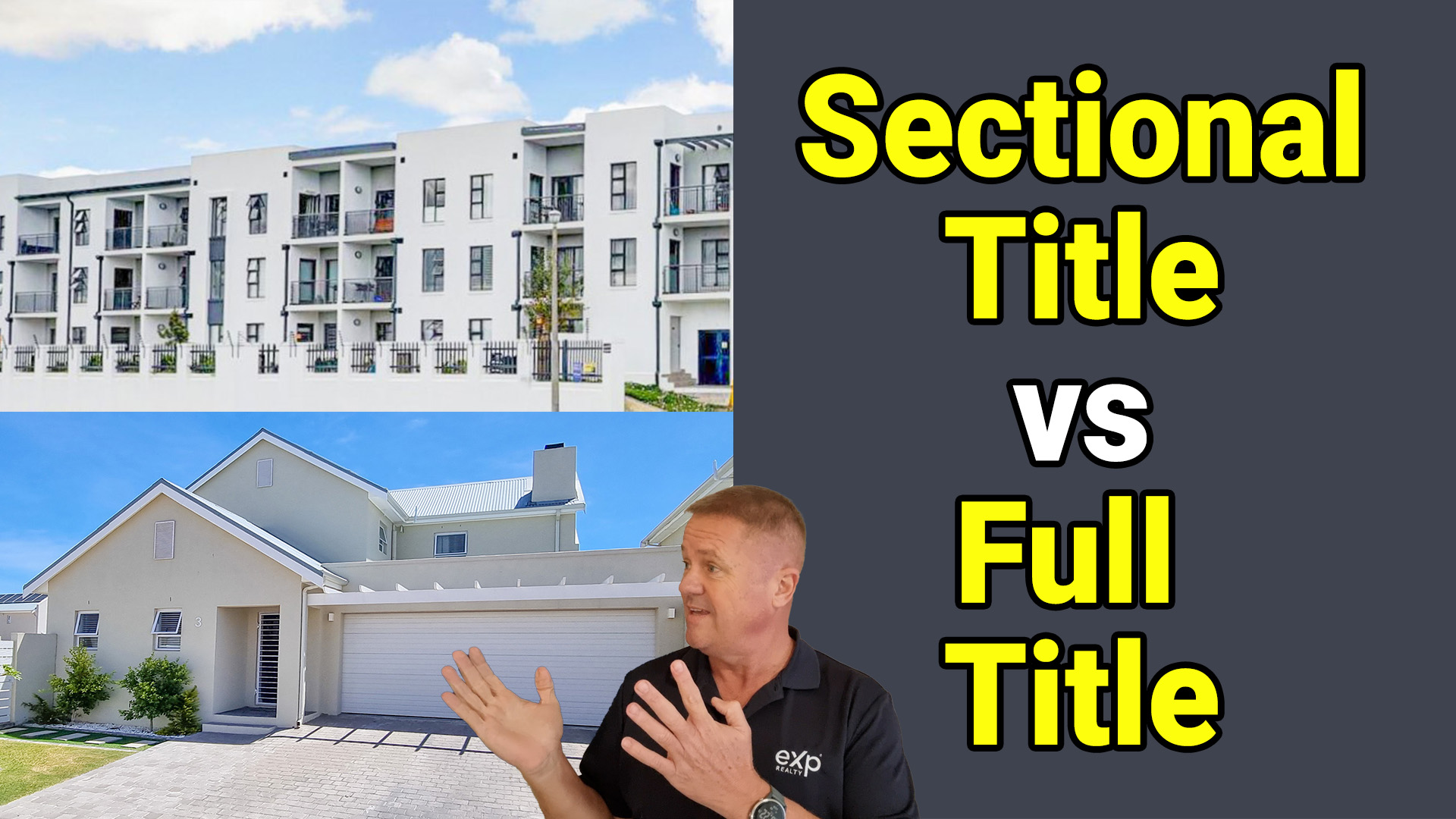
-Sectional Title vs Freehold (Full Title) Property:
-Sectional Title vs Freehold (Full Title) Property:
Terms like freehold, full title, and sectional title are often used, but what do they actually mean for you as a homeowner? Each type of property comes with its own set of rights, responsibilities, and financial implications. By understanding these key differences, you’ll be better equipped to navigate your options and make confident decisions.
1. First up, let’s talk about Ownership and Title Deeds
With Freehold ( (or Full Title) Property:
You own both the land and the building on it—100%.
Your property has its own individual erf number, and you’re responsible for everything – maintenance, insurance, and all improvements.
With Sectional Title Property:
You own a specific unit within a shared development.
The most common example is an apartment in a block of apartments. But townhouses and other properties might also be registered as sectional title, depending on the circumstances.
Within a sectional title development there will also usually be shared or communal areas – think gardens, passageways, pools, and communal parking, which are all jointly owned by all unit owners and managed by a body corporate.
The property is registered under a sectional title scheme, which is governed by the Sectional Titles Act.
2. You’ll often hear about Exclusive Use Areas (EUAs) in Sectional Title developments, which is something that can cause confusion….
Some sectional title schemes allocate exclusive-use areas (EUAs) to specific unit owners, even if they are not registered as separate sections or units, such as for example:
Parking bays, private gardens, storage rooms, balconies, patios, and sometimes garages.
EUAs can either be formally registered on the title deed, OR simply allocated through body corporate rules.
Before buying, always clarify what areas are exclusively yours to use, to avoid misunderstandings.
3. Let’s discuss The Role of the Body Corporate, Trustees, and Meetings in Sectional Title Developments…
Body Corporate: Consists of All the unit owners in the scheme, and is responsible for managing the complex – maintenance, security, finances, insurance and so on.
The Trustees: are elected by the body corporate elects trustees to handle the day-to-day management of the scheme, such as collecting levies, paying expenses, and enforcing the rules.
Meetings & Decisions:
The Annual General Meeting (AGM) is held once a year – where the owners review the financial statements, approve budgets, vote on any necessary issues, and elect trustees.
A Special General Meeting (SGM) can also be called if urgent interim decisions need to be made.
4. Financial Management of the Body Corporate, and Levies:
This is a big one! Let’s talk money….
-LEVIES are raised by the Body Corporate to cover shared expenses, such as:
Building insurance, Security (if applicable), Maintenance, Management fees, as well as to make provision for Future maintenance & upgrades, and so on.
Levies can of course increase over time, depending on what’s needed.
-HOW ARE LEVIES CALCULATED?
Each owner will pay levies based on their Participation Quota (PQ) – which is basically the size of their unit compared to the whole scheme. So the Bigger the unit, the Higher the levy. And the Smaller the unit, the Lower the levy.
SPECIAL LEVIES may Sometimes be charged over and above the normal levies, to pay for unexpected costs or major projects.
5. BEFORE BUYING INTO A SECTIONAL TITLE SCHEME, IT IS ADVISABLE TO REQUEST:
The latest financial statements of the body corporate, so that you can assess whether the scheme is in a healthy financial position. If needed, get an accountant to review the financial statements.
Also get hold of A copy of the complex rules to look at before you buy, so you know what is and what isn’t allowed… for example you don’t want find out when it is too late that you may not be allowed to keep your beloved pet on the property. Some schemes also prohibit short-term rentals (like Airbnb), so please check the rules if that’s important to you. Some sectional title schemes strictly enforce parking and visitors parking rules, so make sure they work for your needs.
You can also request the Minutes of the Last AGM (Annual General Meeting)… This gives insight into issues affecting the scheme, such as maintenance concerns, special levies, or potential financial troubles.
-What are Managing Agents?
Many sectional title schemes appoint a managing agent to handle some of the administrative and financial tasks, such as collecting levies, overseeing maintenance, and ensuring legal compliance under the Sectional Titles Management Act.
-What about Municipal rates and Taxes? With both freehold as well as sectional title, You will also be required to pay municipal rates & taxes.
6. What are some of the Legal Implications of Each Different Ownership Type?
With Freehold Property: You have full rights to alter or extend your property – as long as you comply municipal zoning and building regulations. If your freehold property is in an estate or other development with an Homeowners’ Association (HOA), there may, of course, be additional rules and levies.
For Sectional Title Property: You must always follow the scheme’s rules, and renovations or changes may require body corporate approval. Also – If you don’t pay your levies, the body corporate can take legal action against you. Sectional title properties fall under the Sectional Titles Act and the Community Schemes Ombud Service Act, which provide structured processes for managing disputes and finances.
7. How does the type of property influence Security & Community Living?
With Freehold Property: Security is 100% your responsibility. You can install electric fencing, alarms, CCTV, etc.
Freehold properties generally offer more privacy, but often have higher individual security costs.
Sectional Title Property: These often have gated access, and sometimes even security guards and CCTV, thereby reducing individual security costs for the owners. Close-proximity living creates a sense of community and safety, but might also mean less privacy.
8. SO! Which One is right for YOU?
This is not always a straightforward answer, but here are some factors to consider:
You could choose Freehold if:
You want full control over your property.
You prefer more privacy and fewer rules.
You’re happy to handle all maintenance and security yourself.
Go for Sectional Title if:
You want lower maintenance responsibilities.
You prefer lock-up-and-go convenience.
You don’t mind following community rules.
Final Thoughts At the end of the day, both freehold and sectional title properties have their pros and cons. The right choice depends a lot on your personal lifestyle preferences, your budget, and your long-term goals.
If you have any questions or need assistance with your property transactions, feel free to contact us:
Please contact us if you have any questions or need guidance on selling or buying property. We specialize in making the process as smooth as possible.
We look forward to hearing from you…
Email: info@PropLA.co.za
Cell: 082 324 7915
WhatsApp: Click here to send us a message.